Cardiff-by-the-Sea, California

A gentler place to heal and grow

Traditional therapy for children, teens, and adults comes first here, with trauma therapy grounded in EMDR and Internal Family Systems (IFS), at a pace that feels safe.

Start with a free 15-minute consultation, a relaxed conversation to make sure we are a good fit.

  • Free 15-minute consultation
  • EMDR trauma therapy
  • IFS, Internal Family Systems
  • Children, teens & adults
Portrait of Julie D. Gruber, LMFT, smiling in front of a green living wall
Julie D. Gruber, LMFT Licensed Marriage & Family Therapist
CA License #150513

Meet your therapist

Hi, I'm Julie

I'm a licensed marriage and family therapist in Cardiff-by-the-Sea, and my work centers on one belief: healing happens when we feel safe enough to be curious about ourselves, including the parts of us that carry pain.

My path to therapy began in the classroom. Before becoming a therapist, I was an elementary school teacher, and that experience still shapes how I work today, with patience, warmth, and a deep respect for how children see the world. It also means I understand families from the inside: I've been married for almost 17 years and I'm raising two teenagers of my own.

With adults, my focus is trauma. I use Internal Family Systems (IFS) as my main approach, alongside EMDR, to help clients process painful experiences and feel more like themselves again.

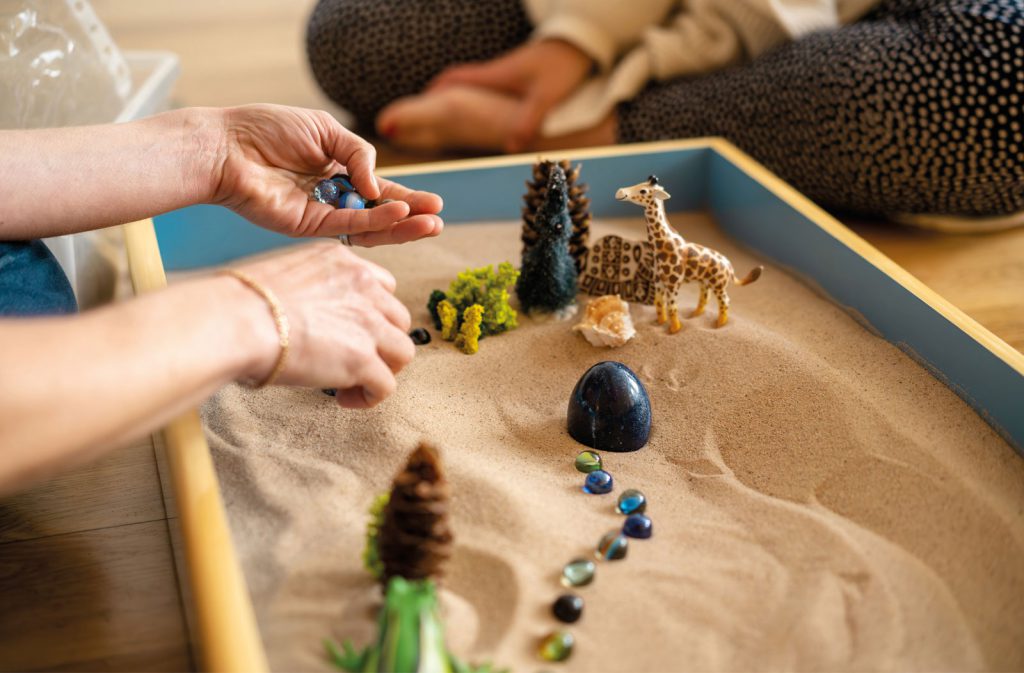
Alongside talk therapy, I also use hands-on, creative interventions when words are hard to find. Because they work through imagery, symbol, and action rather than words alone, these approaches engage the unconscious (the implicit, nonverbal processes that talking can't always reach). Sand tray and art interventions aren't just for children. Many adults use them to work through trauma, grief, and life transitions, while play interventions give children a natural way to express feelings and practice new ways of coping.

As I put it on my Psychology Today profile: we go to school to learn many subjects, but how to handle our emotions is rarely one of them, even though emotions are woven into every part of life. Helping you, or someone you love, work through those emotions is exactly what I am here for.

Focus areas

What I can help with

A quick overview of the areas clients most often come to me for, across children, teens, adults, and families. My top focuses on Psychology Today are trauma and PTSD, working with children, anxiety, and depression.

  • Trauma and PTSD
  • Anxiety
  • Depression
  • Stress
  • Relationship issues
  • Family conflict
  • Parenting
  • Life transitions
  • Grief
  • Children and teens
  • School and behavior concerns
Services · My Growth Therapy

Ways we can work together

Traditional therapy comes first, with trauma therapy grounded in EMDR and Internal Family Systems (IFS) for when you are ready to go deeper.

Every service starts with a free 15-minute consultation, a relaxed conversation to make sure we are a good fit.

← Back to home

Services

Ways we can work together

Traditional therapy is listed first, followed by trauma therapy. Life coaching lives on its own page. Not sure which fits? That is exactly what the free consultation is for.

For everyday challenges & growth

Traditional Therapy

Supportive talk therapy for individuals and families: stress, relationships, parenting, life transitions, grief, and the general weight of a full life. A steady, judgment-free space to talk things through and find your footing again.

Approaches I draw on:
  • EMDR
  • IFS, Internal Family Systems
  • Individuals
  • Families
For trauma & painful experiences

Trauma Therapy

Specialized therapy for trauma and the experiences that stay with us: anxiety that won't quiet down, memories that keep resurfacing, patterns you can't seem to shake. Sessions draw on EMDR and IFS to help your mind and body finally process what happened, so it stops running the present.

  • EMDR
  • IFS

My approach

EMDR and IFS, side by side

Right under traditional therapy, here are the two approaches I use most. EMDR sits on the left and IFS sits right next to it, because in practice they work beautifully together, and neither requires you to relive every detail out loud.

EMDR

Eye Movement Desensitization & Reprocessing

EMDR helps the brain reprocess memories that got "stuck," the ones that still feel raw, vivid, or triggering long after the event is over. Using guided eye movements or other gentle bilateral stimulation, we help those memories lose their charge.

The memory doesn't disappear; it simply becomes something that happened, rather than something that keeps happening. EMDR is one of the most well-researched treatments for trauma and PTSD.

Read more about EMDR therapy in Cardiff, including how it works, what sessions are like, and answers to common questions.

IFS · My main modality

Internal Family Systems

IFS is built on a simple, compassionate idea: we all have different "parts" inside us, a protective part, a critical part, a part that still hurts from long ago. None of these parts are bad; most are just trying to help in the only way they know how.

In IFS work, we get to know these parts with curiosity instead of judgment, help them relax their grip, and let your calm, confident core self lead. Clients often describe it as finally feeling at peace inside their own mind.

Read more about IFS therapy in Encinitas and how getting to know your parts can help with trauma, anxiety, and depression.

Looking for life coaching?

Coaching is separate from therapy, so it has its own page with what it covers and how it works.

Visit the Life Coaching page
Children & Teens · My Growth Therapy

Therapy that meets kids where they are

Children and teens rarely talk through big feelings the way adults do. Sessions here work through play, art, and sand tray interventions, with parents as partners every step of the way.

Start with a free 15-minute consultation. We will talk through what your child is facing and whether now is the right time to begin.

← Back to home

Children & teens

Therapy that speaks a child's language

Children rarely sit down and talk about their feelings the way adults do. They show us through play, art, and stories. As a former elementary school teacher and a mom of two teens, I build sessions around how kids naturally express themselves.

I work with children of most ages, from young children through teenagers, on anxiety, big feelings, behavior struggles, family changes, and difficult experiences. It does depend on the child, though. Some children aren't ready for therapy yet, and we'll talk through whether now is the right time during your free consultation. I also find therapy works much more effectively when family sessions run in unison with the sessions I have with your child, so parents are part of the process rather than waiting outside it. The goal, whenever possible, is for the family to work together, supporting your child and each other along the way.

  • Sand tray interventionsChildren build worlds in a tray of sand with miniature figures, a safe, wordless way to show what's going on inside.
  • Play & art interventionsGames, drawing, and creative projects that help kids process emotions, practice coping skills, and build confidence.
  • Parent partnershipYou'll always know how therapy is going and how to support your child at home between sessions.
A child arranging miniature figures, a giraffe, trees, and stones, in a sand tray during therapy

Wondering if therapy could help your child?

Book a free 15-minute consultation. We’ll talk about what your child is facing, whether they are ready for therapy right now, and what working together could look like, with no pressure either way.

EMDR Therapy · Cardiff, CA

EMDR Therapy in Cardiff, CA

EMDR therapy is one of the most effective ways I know to help your brain heal from experiences that still feel present, even years later. At My Growth Therapy in Cardiff, EMDR helps adults and teens process trauma at a pace that feels safe, without having to retell every painful detail out loud.

Start with a free 15-minute consultation, a relaxed conversation to ask questions and see whether EMDR is right for you.

← Back to home
Waves along the Cardiff-by-the-Sea coastline, a few minutes from the office where EMDR therapy in Cardiff takes place
The Cardiff coast, a short stroll from the office.

What it is

What is EMDR therapy?

EMDR stands for Eye Movement Desensitization and Reprocessing. It is a structured, research-backed approach to therapy, and it is recognized by organizations like the World Health Organization and the American Psychological Association as an effective treatment for trauma and PTSD.

Here is the idea behind it. When something overwhelming happens, the brain sometimes stores the memory in a raw, unprocessed form, along with the images, sounds, body sensations, and beliefs from that moment. Later, something ordinary can stir that memory up, and it feels less like remembering and more like reliving.

EMDR helps your brain finish processing those memories, so they can be stored the way ordinary memories are: as something that happened in the past, not something that keeps happening now.

The process

How EMDR therapy works

During EMDR, you bring a memory to mind briefly while following a form of bilateral stimulation: usually my fingers moving back and forth for your eyes to follow, or gentle alternating taps or tones. This side-to-side stimulation seems to help the brain do what it naturally does during deep sleep, sorting, processing, and filing experiences away.

You stay fully awake and in control the whole time, and we can pause whenever you need to. Many clients never describe the memory in detail at all. Over a series of sessions, the memory loses its emotional charge. Clients often say something like, "I know it happened, but it doesn't run my life anymore."

  • We build safety first, including calming tools you can use between sessions
  • We identify the memories and present-day triggers that still carry a charge
  • You focus briefly on a memory while following guided eye movements or gentle taps
  • We check in often so you can notice what is shifting: images, feelings, body sensations, beliefs
  • The memory settles into the past, and the distress connected to it fades

In the room

What EMDR therapy sessions are like

An EMDR session is unhurried and structured, and it may feel different from regular talk therapy. Some sessions are mostly preparation, where we build the coping tools that make processing feel manageable. Others are spent actively working through a memory, with space at the end to settle and talk about what came up.

There is no homework and nothing to perform. Some people feel tired after a processing session, the way you might after a deep emotional conversation, so I always recommend a little margin in your day afterward when you can.

In my practice, EMDR often works hand in hand with IFS, my main approach. Where EMDR helps the brain reprocess specific memories, IFS helps you build a kinder, calmer relationship with the parts of you that carry the pain. You can read more about IFS therapy in Encinitas on its own page.

What it helps

EMDR for trauma, PTSD, anxiety, and depression

EMDR was developed for trauma, and that is still where it shines brightest. But because so much of our present-day pain grows out of earlier experiences, it can help with far more than a single diagnosis.

Trauma and PTSD

This is the heart of EMDR. Whether the trauma was a single event or something that built up over years, EMDR helps your nervous system learn that the danger is over. Flashbacks, nightmares, hypervigilance, and that constant braced feeling can soften as the memories are finally processed.

Anxiety

Anxiety often has roots in experiences your nervous system learned from: the moment you were embarrassed, frightened, or hurt, and the lesson it took from it. EMDR works on those roots, not just the symptoms, so the worry has less to feed on.

Depression

Depression can grow out of painful beliefs formed in hard moments, beliefs like "I am not enough" or "It was my fault." EMDR helps process the experiences underneath those beliefs, which can lift the heaviness in a way that willpower alone never could.

What clients bring to EMDR

  • A single difficult event that still feels fresh
  • Childhood experiences that shaped how you see yourself
  • Accidents, medical trauma, or sudden loss
  • Panic, phobias, and persistent worry
  • Grief that feels stuck
  • Relationship patterns you cannot seem to shake

FAQ

Questions about EMDR, answered

Where can I find EMDR therapy near me in North County San Diego?

My office is in Cardiff, at the Cardiff Executive Center, 120 Birmingham Dr., Unit 140, just off the Birmingham exit west of the 5. Clients come to me for EMDR therapy from across North County San Diego, including Encinitas, Solana Beach, Carlsbad, Del Mar, and San Marcos, as well as from Cardiff itself.

Do I have to talk about the traumatic event in detail?

No. This is one of the things clients appreciate most about EMDR. You will hold the memory in mind, but you do not have to describe it out loud for the processing to work. That makes EMDR a good fit for experiences that feel too painful, private, or hard to put into words.

How many EMDR sessions will I need?

It depends on what we are working through. Some people feel a real shift within a handful of sessions focused on one event. More complex or long-standing trauma usually takes longer, and we will build coping skills first so the work feels safe. We will talk through what to expect during your consultation and check in on pacing together as we go.

What does EMDR feel like?

Most clients describe it as focused and surprisingly calm. Your eyes follow my fingers, or you feel a gentle tap, tap, tap alternating on your hands or knees, while thoughts, feelings, and images drift through. You are awake, aware, and in control the entire time, and we stop whenever you need a break.

How do I get started with EMDR therapy in Cardiff?

Start with a free 15-minute consultation. We will talk about what is bringing you in, I will answer your questions about EMDR, and together we will decide whether it is the right fit. Call (858) 349-9018 or email [email protected].

Ready to feel like the past is in the past?

Book a free 15-minute consultation. We will talk about what you are carrying, I will explain how EMDR therapy could help, and together we will decide if My Growth Therapy is the right fit, with no pressure either way.

IFS Therapy · Encinitas & San Diego County

IFS Therapy in Encinitas & San Diego County

If you are looking for an IFS therapist in San Diego County, my office in Cardiff serves clients across North County. IFS therapy helps you understand the different parts of yourself with compassion instead of criticism, so old pain can loosen its grip and you can feel like yourself again.

Start with a free 15-minute consultation, a relaxed conversation to ask questions and see whether IFS is right for you.

← Back to home
A bright wheat field with yellow flowers near the Cardiff office offering IFS therapy in Encinitas and North County San Diego
A calm North County landscape, close to the office.

What it is

What is IFS therapy?

IFS, or Internal Family Systems, is my main approach as a therapist, and it starts with an idea most people recognize as soon as they hear it: we all have different parts inside us. A part of you wants to speak up, and another part holds you back. A part criticizes everything you do, while another part just wants to rest.

IFS was developed by Dr. Richard Schwartz, and it treats these parts the way you would members of a family: each one has its own feelings, its own history, and its own reasons for behaving the way it does. None of them are bad. Most are trying to protect you, often in ways they learned long ago.

In IFS therapy, we get curious about your parts instead of fighting them. As they begin to feel understood, they can relax, and your calm, confident core self, what IFS simply calls Self, can lead. Clients often describe it as finally feeling at peace inside their own mind.

The parts

How IFS works: getting to know your parts

IFS describes our inner world in a few simple terms. You do not need to memorize them; they are just a gentle map for the work we will do together.

  • Managers: the organized, careful parts that plan, achieve, and try to keep everything safe and under control
  • Firefighters: the parts that rush in when pain breaks through, sometimes with numbing, avoiding, scrolling, snacking, or lashing out
  • Exiles: the younger, tender parts that carry old hurt, fear, and shame, usually kept tucked away so daily life can go on
  • Self: your calm, curious, compassionate core, which every person has, no matter what they have been through

In session, we slow down and listen to whichever part needs attention. Often we find that a part you have been frustrated with for years, like a harsh inner critic, has been working hard to protect a younger part of you all along. When that protection is no longer needed in the same way, the critic can soften, and the younger part can finally heal.

In the room

What an IFS session is like

IFS sessions are gentle and conversational, with quiet moments to turn inward and notice what is happening inside: a tightness in your chest, an image, a younger version of you. You are always in charge of the pace, and you never have to share anything before you are ready.

IFS for trauma

Trauma often leaves parts of us frozen in the moment it happened. IFS gives those parts a safe way to be heard and unburdened, with your adult Self leading the process. Because the work is paced by your own system, many people find it a gentler way into trauma healing.

IFS for anxiety and depression

Anxiety is often a protective part working overtime, and depression can be a system that has gone quiet to cope. IFS helps you understand what those parts are protecting you from, so the protection itself can ease.

IFS and EMDR pair well together. Many of my trauma clients use both: IFS to build a kinder relationship with their inner world, and EMDR therapy in Cardiff to reprocess specific painful memories.

FAQ

Questions about IFS, answered

Where can I find IFS therapy near me?

My office is in Cardiff, at the Cardiff Executive Center, 120 Birmingham Dr., Unit 140. As an IFS therapist, I see clients from across San Diego County and North County, including Encinitas, Solana Beach, Carlsbad, Del Mar, and San Marcos.

How is IFS different from regular talk therapy?

Talk therapy works mostly with your thoughts about a problem. IFS goes a layer deeper, to the parts of you that carry the feelings underneath. Instead of analyzing a reaction, we get to know the part having it. Clients often find that this is where lasting change happens.

Do I need therapy experience to try IFS?

Not at all. If you have ever said "part of me wants to, and part of me is scared to," you already understand the basic idea. We will go at your pace, and I will guide you through every step.

How do I get started with IFS therapy?

Start with a free 15-minute consultation. We will talk about what is bringing you in, I will answer your questions about IFS, and together we will decide whether it is the right fit. Call (858) 349-9018 or email [email protected].

Ready to feel at peace inside your own mind?

Book a free 15-minute consultation. We will talk about what you are facing, I will explain how IFS therapy could help, and together we will decide if My Growth Therapy is the right fit, with no pressure either way.

Therapy for children & teens

Sessions built around how kids actually express themselves, through play, art, and sand tray, with parents as partners in the process.

Visit the Children & Teens page

Visit

In the heart of Cardiff-by-the-Sea

  • Office Cardiff Executive Center
    120 Birmingham Dr., Unit 140 (bottom level)
    Cardiff, CA 92007
    Just off the Birmingham exit, west of the 5, minutes from Encinitas, Solana Beach, and Del Mar.
  • Hours Monday–Friday, 9am–6pm
  • Areas served Cardiff, Encinitas, Solana Beach, Carlsbad, Del Mar, and San Marcos, in North County San Diego.
Aerial view of the Cardiff-by-the-Sea coastline, with waves along the beach and hillside homes
The Cardiff-by-the-Sea coastline, a short stroll from the office.

Ready to take the first step?

Book a free 15-minute consultation. We'll talk about what's bringing you in, I'll answer your questions, and together we'll decide if My Growth Therapy is the right fit, with no pressure either way.

Life Coaching · My Growth Therapy

Coaching for clarity, goals, and momentum

Forward-focused coaching for people who are not looking for therapy, but want a thoughtful partner in getting unstuck and moving toward what matters next.

Coaching also starts with a free 15-minute consultation, so we can confirm coaching is the right fit for your goals.

← Back to therapy services

Life coaching

What coaching is, and what it is not

Coaching and therapy are different kinds of support. This page keeps coaching separate, so you can choose the one that fits where you are right now.

Coaching

Looking forward

Coaching is practical, encouraging, and structured around where you want to go next. We set clear goals, break them into doable steps, and check in on progress together.

People often use coaching for navigating a transition, building new habits, clarifying direction, or getting unstuck when they know what they want but cannot seem to start.

Therapy

Healing what is behind you

Therapy is for processing painful experiences, easing symptoms like anxiety, and understanding patterns that keep repeating. At My Growth Therapy, that work is led by traditional therapy and trauma therapy with EMDR and IFS.

If healing is what you need most, start on the services page instead. See therapy services.

How it works

Three simple steps

1

Free consultation

A relaxed 15 minute call to talk about what you want to work on and confirm that coaching, not therapy, is the right fit.

2

Set clear goals

Together we name what success looks like for you, whether that is a transition, a habit, a decision, or a new direction, and map the first steps.

3

Steady follow-through

Ongoing sessions keep you accountable and supported as you take action, adjust the plan, and build real momentum.

  • Life transitions
  • Goals and habits
  • Confidence and direction
  • Parenting and family balance
  • Getting unstuck

Ready to move forward?

Book a free 15-minute consultation. We will talk about your goals, I will answer your questions, and together we will decide if coaching is the right next step.